Parent Circle
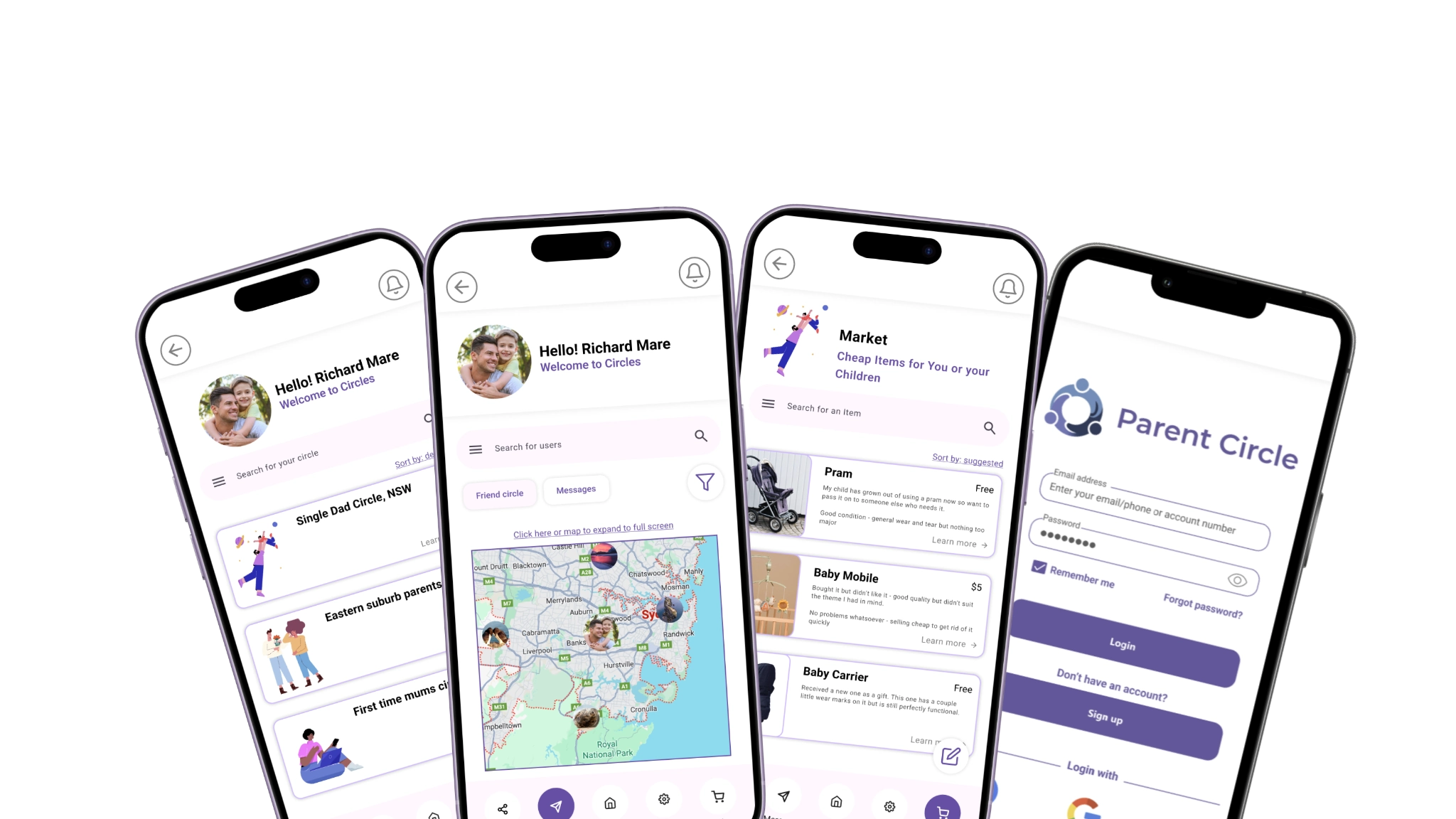
Support platform for the first years of parenthood. Local parent circles, verified childcare reviews, and a safer peer-to-peer marketplace, in one place, for parents of children aged 0–4.
The Problem
The transition to early parenthood in Australia is shaped by three converging pressures: social isolation, uncertain or conflicting guidance, and financial strain. For parents of children aged 0–4, these pressures arrive simultaneously. The resources meant to help are scattered across health portals, government websites and social media groups, with no connecting thread and no reliable way to know what to trust.
In a survey of 25 Australian parents, 33% turned to friends and family first for guidance, not health professionals or formal services. Over half reported checking social media advice against another source before acting on it. Parents aren’t short of information. They’re short of a way to know which of it to trust.
Research
Triangulated across surveys (n=25 Australian parents and caregivers via Google Forms), semi-structured interviews with parents of children aged 0–4, and online ethnography through shadow observation of Mouths of Mums, Beyond Blue forums, and Mamamia comment threads.
Credible guidance, fast
Exhausted parents needed short, trustworthy answers quickly. Online forums often added conflicting advice and judgement alongside any genuine support. Access to information didn’t reliably reduce anxiety.
Financial strain and childcare access
Childcare costs created constant, often invisible trade-offs: reduced work hours, deferred services, difficult decisions made silently under pressure. Navigating options felt opaque and overwhelming.
Belonging with guardrails
Connection mattered more than information. Parents with strong local networks reported higher confidence regardless of circumstance, but peer support required structure and trust to feel safe rather than exposed.
Ideation
I explored the problem space through five methods. Mind-mapping narrowed 20+ life transitions down to parenthood, then Crazy 8s and bodystorming pushed on it further, the latter by physically acting out the “freeze moments” of parental stress. Worst Possible Idea did the most work: it flipped “Mandatory Bootcamp” into flexible optional support, and “AI Robot Babysitter” into augmented human care with oversight. A PMI matrix then evaluated the eight concepts the five methods produced.
Two concepts progressed: Village (a credible knowledge hub with health tracking) and Parent Circles, the concept that became Parent Circle (a community-focused platform built around social connection and local support). The PMI evaluation selected Parent Circles for its “strongest social and emotional benefits”, directly addressing the research finding that parents with strong local networks reported higher confidence regardless of circumstance.
Key Features
Local Circles & Community Reviews
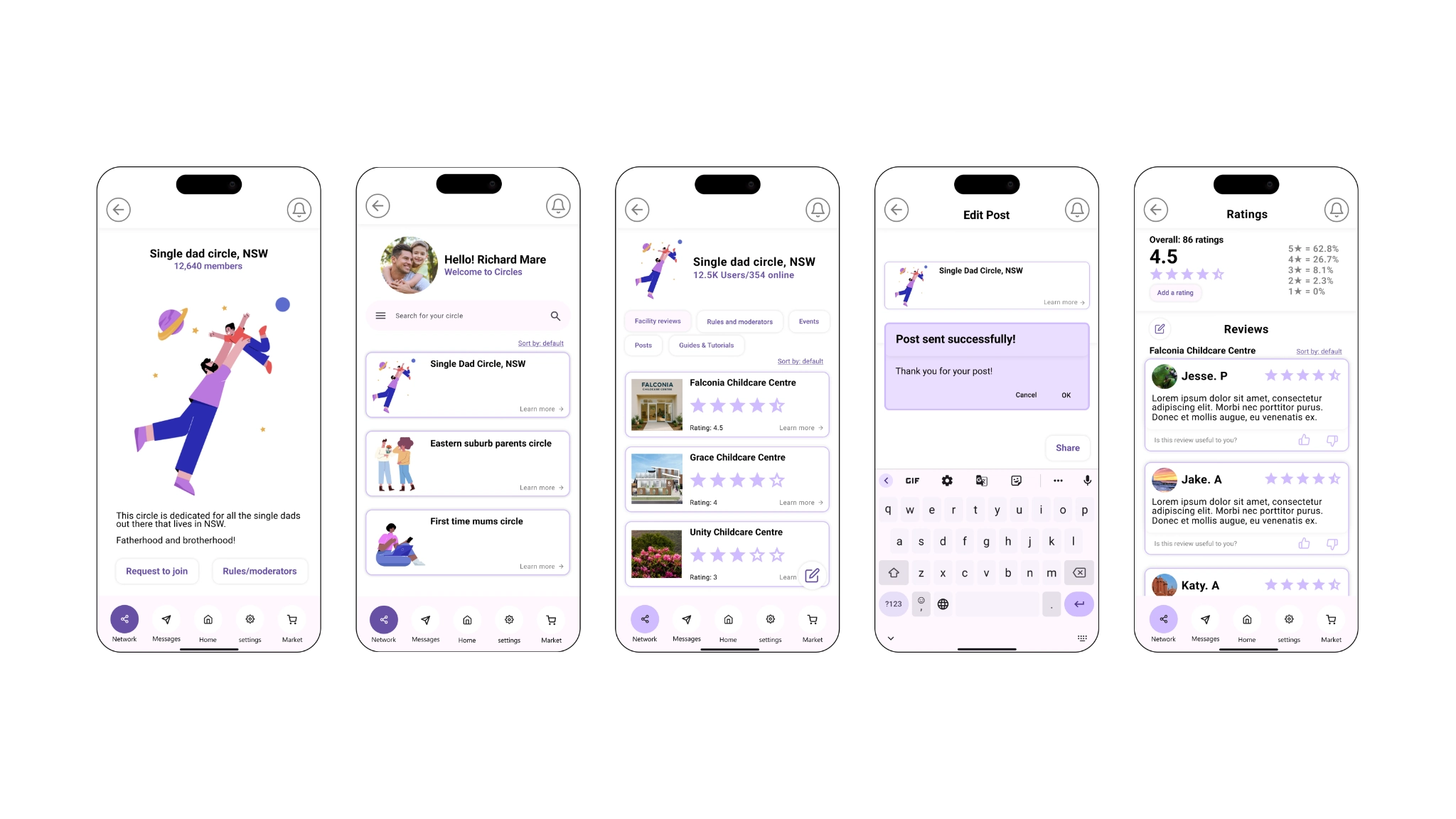
Parents are grouped by location and life stage: Single Dad Circle NSW, Eastern Suburb Parents, First Time Mums. Advice and recommendations come from people in genuinely similar circumstances. Integrated childcare reviews let parents read and contribute ratings for local facilities, surfacing lived experience from their own community rather than anonymous online forums. Interaction design prioritised large tap targets and clear visual hierarchy for parents navigating one-handed under time pressure.
Verified Community Marketplace
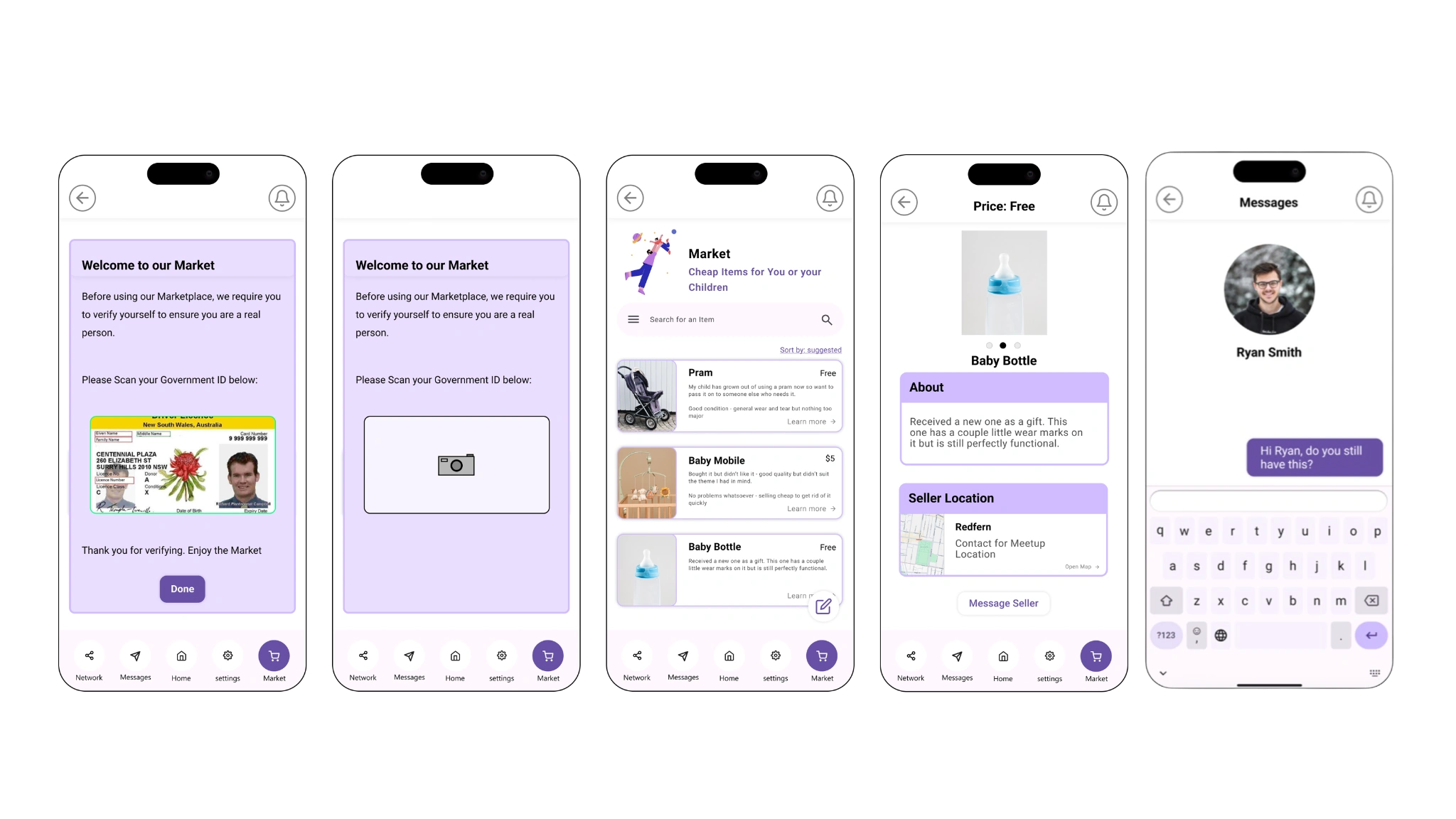
Parents exchange, borrow, or gift childcare items through a peer-to-peer marketplace that requires identity verification before access. Seller locations are now shown at suburb level only, not precise addresses. That came out of testing, where exact addresses raised clear privacy concerns. The verification step itself turned out to matter more than any visual design decision on the page.
Proximity-Based Friend Matching
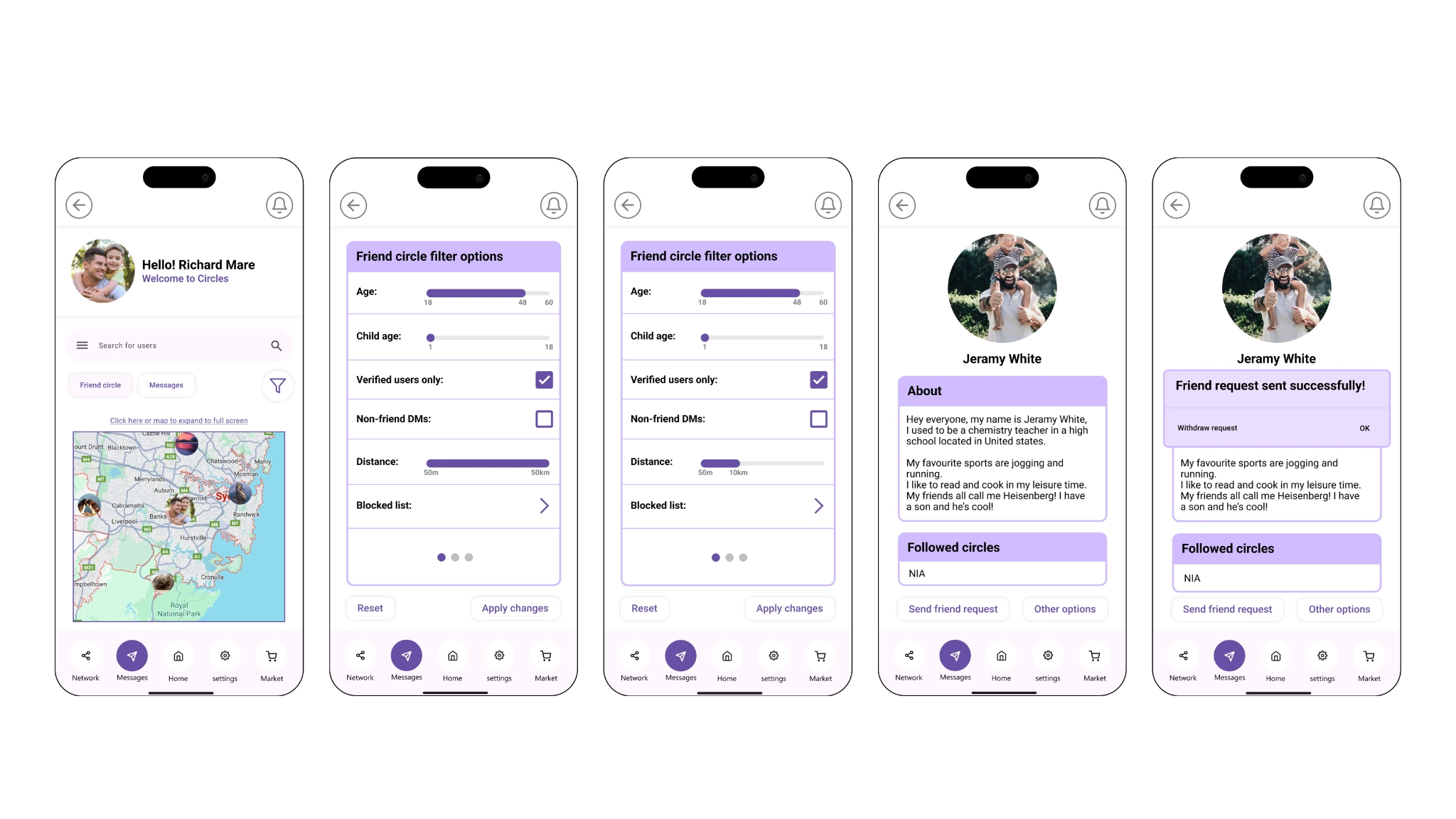
Isolation was one of the three strongest findings in the research, reported by 68% of surveyed parents. The friend matching system addresses this directly, helping parents find nearby people with similar schedules and childcare stages. Filters let users control who they’re visible to, and friend requests include a withdraw option so the process feels low-pressure rather than socially committing.
Testing
Mid-to-high fidelity Figma prototype tested with 8 participants (peers and tutors) at an in-class User Testing Fair. Two-station setup: Station 1 ran think-aloud with facilitator, observer, and Wizard of Oz operator; Station 2 handled interviews and surveys.
Each participant completed three task-based scenarios. Every task captured success/failure, completion time, error count, and a Single Ease Question (SEQ) score (1–7), followed by a structured interview and unstructured follow-up. 35 data points were synthesised into an affinity diagram.
- Task A: Join a local circle, post an introduction, find childcare reviews. Testing navigation, posting, and review system clarity.
- Task B: Complete identity verification, find a free item, post a new listing. Testing trust in verification and marketplace usability.
- Task C: Apply filters and send a connection request. Testing filter mechanics and social comfort.
What Worked
What Needed Improvement
Iterations
Ratings discoverability
Rating entry point was tiny, easy-to-miss text below the score.
A prominent “Add a rating” button below the score, plus a pencil icon on every facility card: two visible entry points.
Privacy and transparency
Sellers shown at an exact address, with no explanation for why ID was required.
Suburb and distance only (“Redfern / 6km from your current location”), plus an onboarding screen explaining the verification step.
Map and profiles
Small, overlapping map avatars with no way to see who you were connecting with.
Enlarged, separated avatars opening full profile pages (bio, circles, friend request) before you send a request.
Reflection
The rule that kept this project coherent was simple: every feature had to answer one of the three research clusters (guidance, money, belonging) or it stayed out.
The finding I keep coming back to is ID verification. It was not part of the original concept; it went in late, to patch marketplace safety concerns. Then testing showed it was the single thing that separated Parent Circle from the alternatives: participants called it “safer than Facebook Marketplace” in their own words. I had spent the project designing for warmth and belonging; the feature that actually earned trust was a verification step.