Olympic Eats
Nutrition and food-service design concept for the Paris 2024 Olympic context. A sustainable ordering application that gives athletes full access to performance nutrition and makes the sustainable choice the easier one at the point of ordering.

The Problem
At the 2024 Paris Olympics, the IOC met its sustainability benchmarks: 250km local sourcing, 100% recyclable packaging, a plant-based emphasis. But athletes experienced a different reality: food shortages, inadequate protein, 30-minute queues, and limited variety. The German hockey team called it “a disaster.” Adam Peaty described “long queues and worms in the fish.” Daria Saville said she’d “need 14 of them right now to feel full.”
However those targets were set, the food athletes relied on became uncertain at the exact moment it mattered most. I asked: how could a digital system give athletes reliable access to performance nutrition while supporting, not undermining, sustainability goals?
Research
Triangulated across three methods: quantitative surveys with 41 high-level athletes, semi-structured interviews with 6 athletes, and an expert interview with Amy McLean, Experience Designer and Biodesigner at frog.
The research phase produced 151 affinity notes organised into 19 groups and 5 themes. Athletes were willing to engage with sustainability, but not at the expense of performance nutrition. Most prioritised animal-based protein and carbohydrates over other food categories, had limited knowledge of plant-based protein equivalents, and defaulted to familiar options under time pressure.
McLean challenged the assumption that education alone could shift behaviour. Sustainability, she argued, is “a buzzword used for marketing”: it’s a systemic issue, not an individual responsibility. That shifted my design direction: stop trying to persuade athletes, and build a system where the sustainable option is the easier one to find and pick.
Performance first
Athletes prioritise animal-based protein for performance. Vegan alternatives are perceived as insufficient in both nutrition and taste.
Willing but uninformed (first reading)
Interest in sustainability exists but knowledge of high-protein alternatives is low. My initial conclusion was that athletes needed education. The expert interview overturned it: the barrier was risk to performance, not missing information.
Systems, not individuals
Competition food systems are built for scale, not precision. Many athletes bring or cook their own food at the Games.
Ideation
Three concepts developed through Crazy 8s, Worst Possible Idea, and Mash-up exercises: an AI nutrition tracker, a food dispensing kiosk, and a feedback-driven ordering app. I evaluated all three using a Pugh Decision Matrix across seven weighted criteria, with performance impact and sustainability weighted highest. The ordering application scored 31.5 out of 33 and was selected.

Key Features
Macronutrient Transparency
Every meal displays its full nutritional breakdown (protein, carbohydrates, fats, calories, and serving size) at the point of selection. The research showed athletes were making choices blind, so the design puts performance data front and centre before any ordering decision is made.
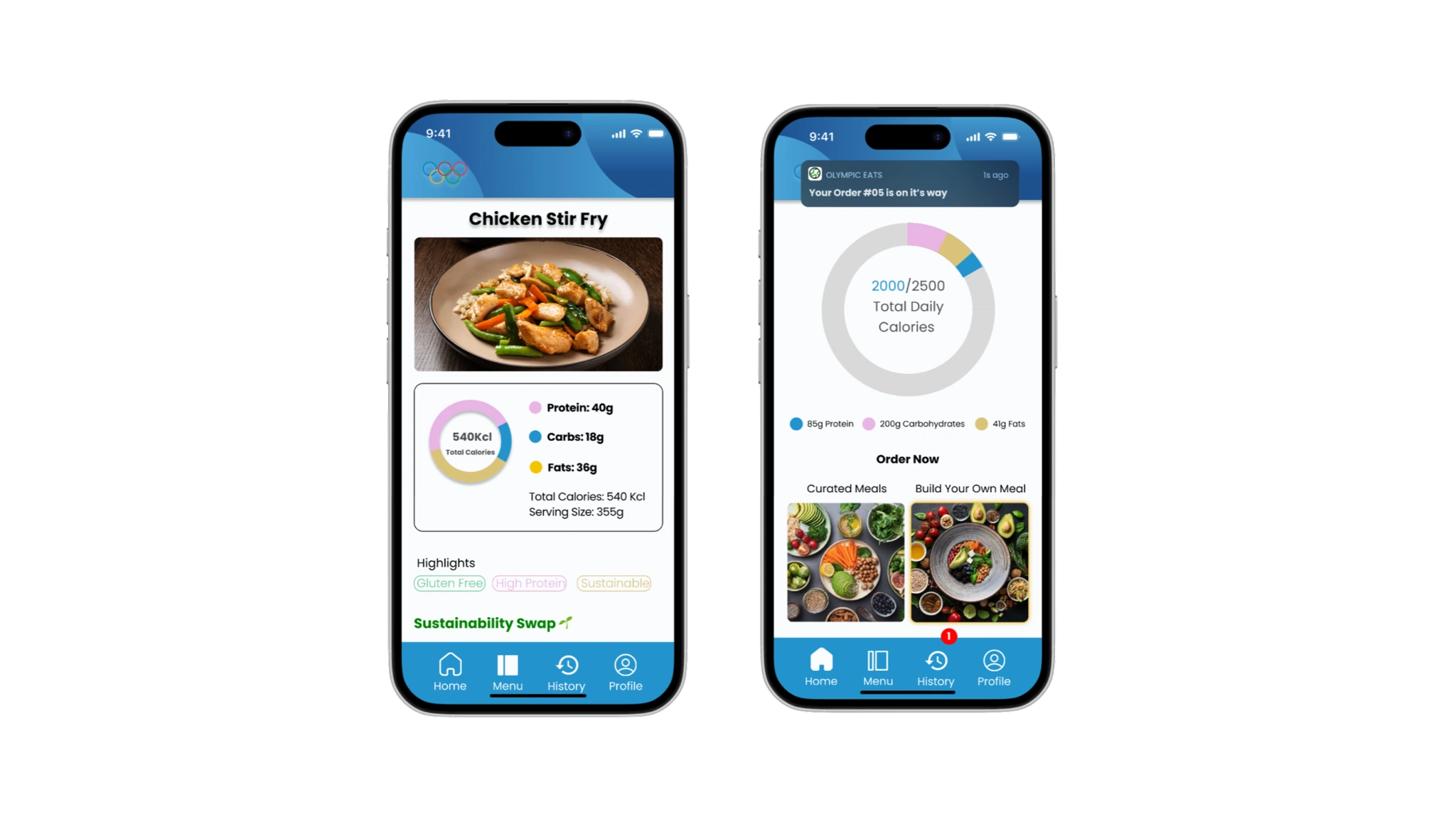
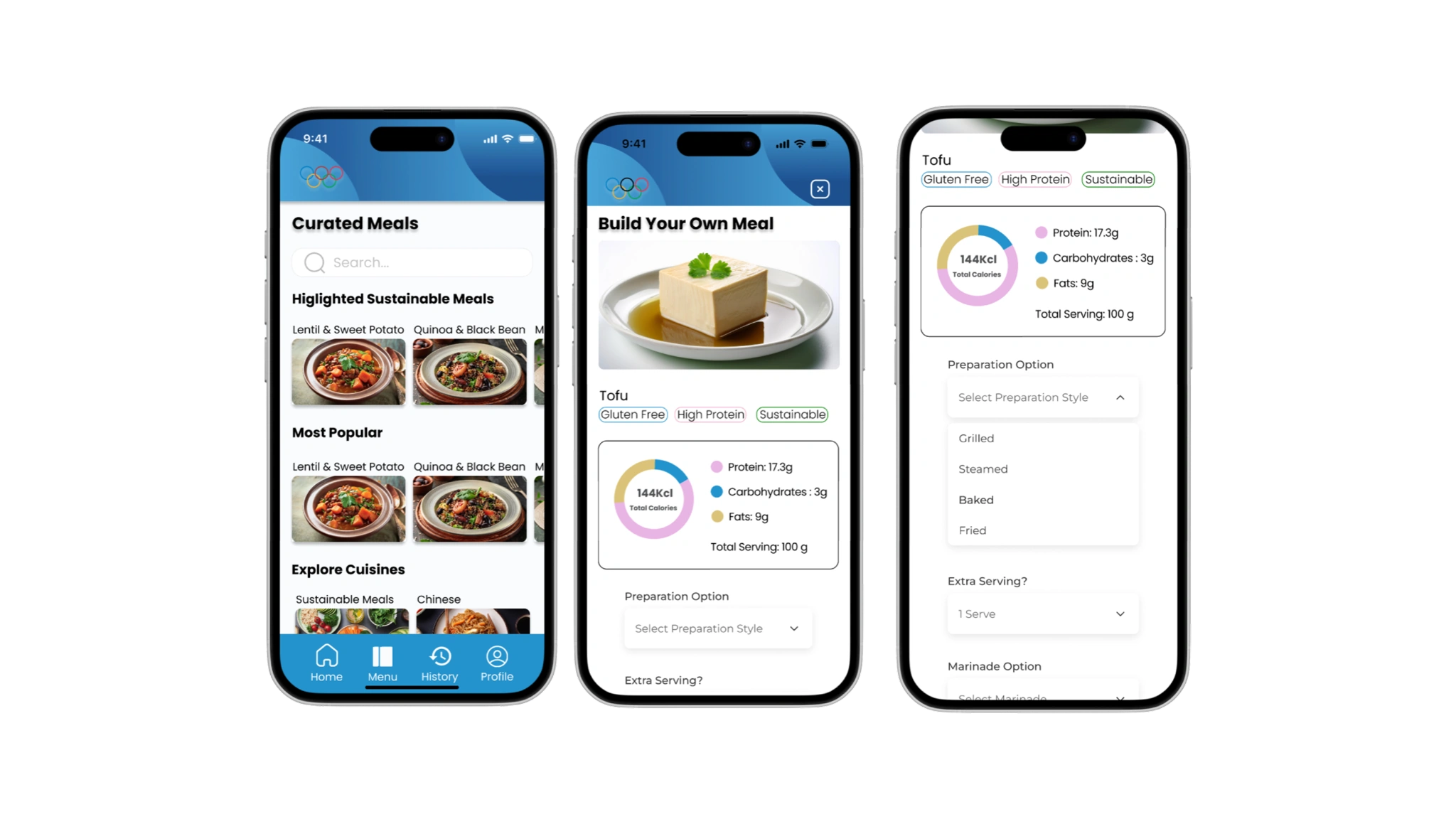
Curated Meals + Build Your Own
Athletes with strict nutritional targets need precision; athletes under time pressure need speed. Two ordering paths solve for both: a curated menu filtered by cuisine, dietary tags, and sustainability rating, and a component-based builder where you choose protein, carbs, preparation method, and marinade individually.
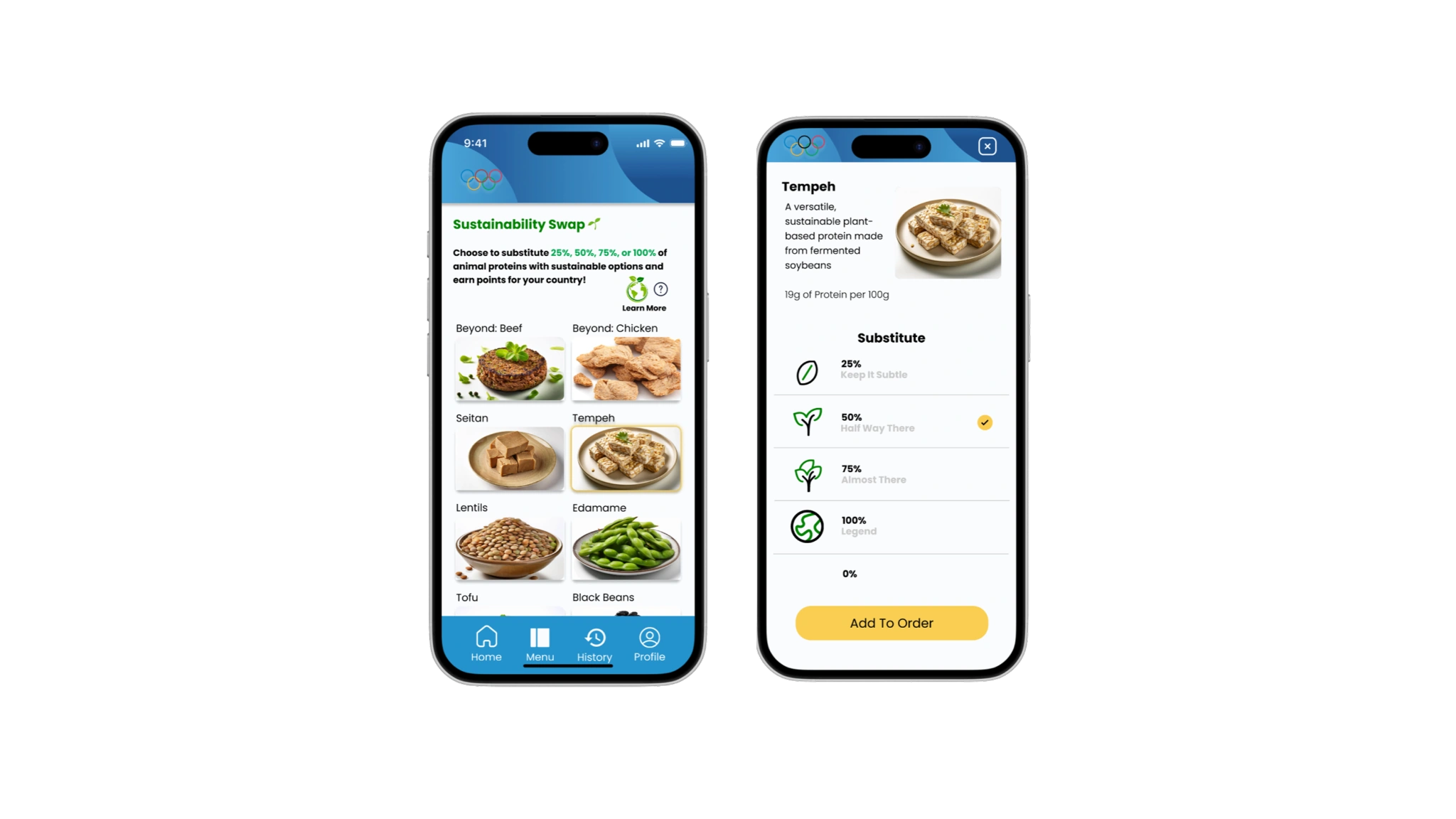
Sustainability Swap
Rather than replacing animal protein, the swap system lets athletes substitute incrementally (25%, 50%, 75%, or 100% plant-based) while maintaining equivalent total protein. This preserves performance-first nutrition as the default while giving athletes a clear, voluntary path toward more sustainable choices. Each substitution earns Sustainability Points for their country. This is the research finding built directly into the interface: athletes will engage with sustainability as long as performance is untouched.
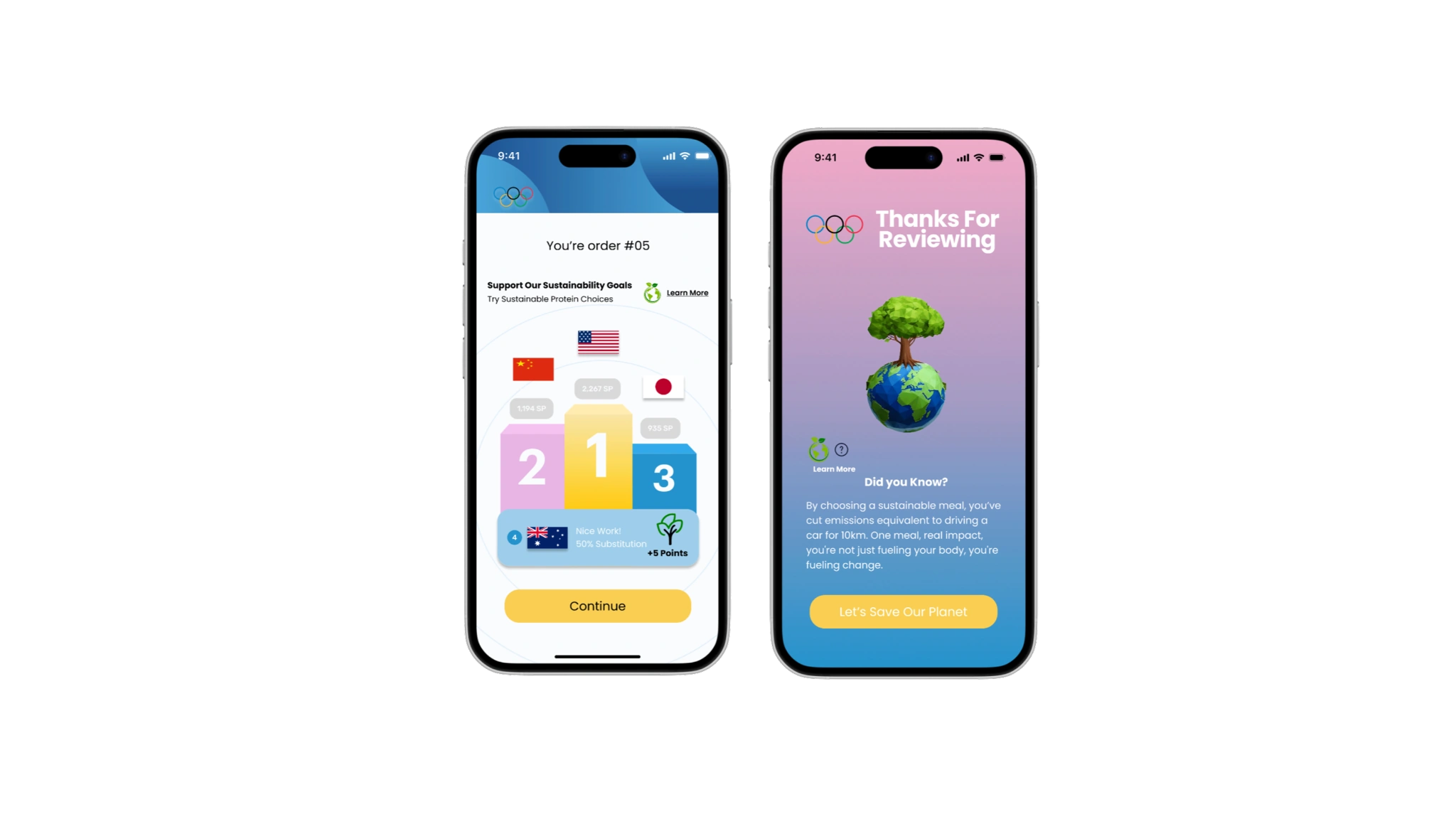
Country Leaderboard + Feedback
Sustainability Points accumulate at a national level, turning individual meal choices into a collective competition between countries. After ordering, a contextual fact translates the choice into tangible environmental impact. Athletes can also rate meals for quality, taste, and performance, feeding back directly to the kitchen management system to improve future offerings.
Testing
Tested with 5 athletes using a four-step protocol: think-aloud task completion → structured interview (4 questions) → SUS survey → unstructured follow-up. In-person testing captured non-verbal cues like hesitation, squinting at labels, and reaching for the wrong button alongside verbal feedback.
13 points above average: Grade A on the Sauro-Lewis scale
69 affinity notes were organised across 11 themes. Three areas needed work:
- Visual feedback: buttons didn’t change state after selection; athletes weren’t sure their choices registered. “I want the buttons to change colour after I click them.”
- Serving clarity: macronutrient display lacked gram-per-serve values; the mix-and-match percentage system was confusing. “I didn’t understand what 50% plant-based meant at first.”
- Education: athletes wanted context on why options are sustainable and how the leaderboard works. “I want education behind what makes the meal sustainable.”
Iterations
Macronutrient labels
No gram values or serving sizes; athletes couldn’t compare meals against their targets.
Explicit gram values, serving sizes, and calorie counts shown at the point of selection, removing the guesswork causing hesitation and mistrust.
Visual feedback
Nothing changed on screen when an option was tapped; athletes weren’t sure it registered.
Selection highlights and order confirmation notifications close the feedback loop at every step.
Onboarding and explanation
Sustainability features (points, leaderboard, swaps) launched with no explanation of why they existed.
A first-launch walkthrough plus contextual facts after each order build understanding over time.
Reflection
The interview with Amy McLean changed this project more than any other input. I went in assuming the job was to educate athletes into better choices. She argued that sustainability fails when it is framed as individual responsibility, and the survey data backed her: the real barrier was not missing information but an unwillingness to gamble performance on an unfamiliar option. So the design stopped trying to persuade. It keeps performance nutrition the default, makes the swap easy to find, and leaves the decision with the athlete.
One round of testing is not enough to settle it. The percentage-based swap confused people until they had used it once, and the onboarding that now explains it was added after testing, so it is untested by definition. Before I would stand behind this concept, it needs a second round with athletes and a first one with the kitchen and food-service staff who would have to run it.